
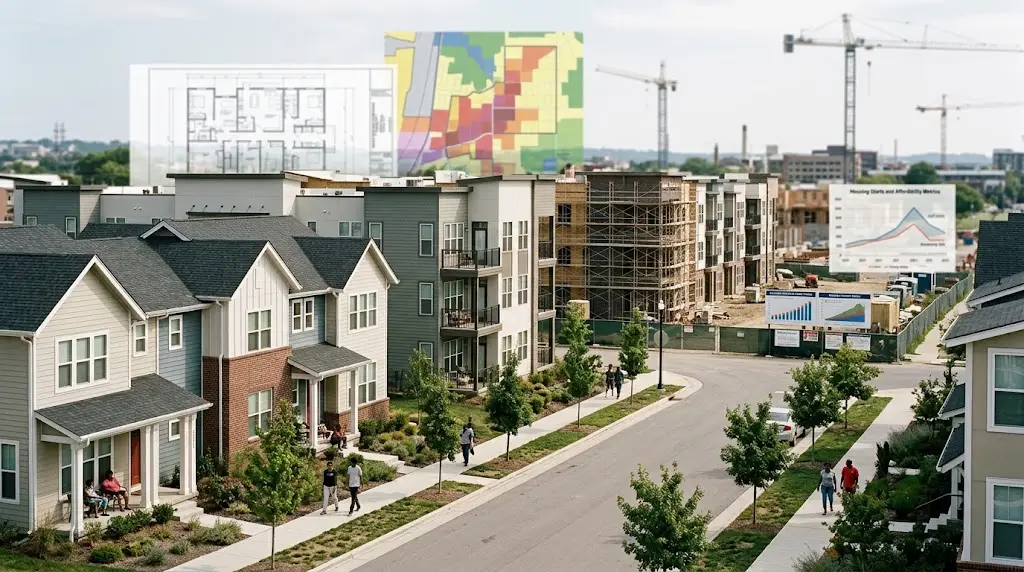
The U.S. housing crisis has many causes, but one issue continues to appear throughout housing research and policy discussions: the country needs more homes that people can realistically afford.
High home prices, elevated rents, limited housing supply, construction costs, financing conditions, land-use regulations, and local permitting requirements can all affect the final cost of housing. Because these factors interact, there is no single policy that can instantly solve housing affordability.
However, a significant shift in U.S. housing policy during 2026 is putting greater emphasis on reducing regulatory barriers to construction, lowering development costs, unlocking land, and speeding up housing production.
The policy direction is important because housing affordability is closely connected to how much housing can be built, how quickly it can be delivered, and how expensive it is to produce.
What Is the New Housing Policy Shift?
In 2026, the U.S. Department of Housing and Urban Development has emphasized reducing regulatory barriers that it says can increase the cost of construction and restrict housing supply.
HUD’s May 2026 State and Local Best Practices for Home Construction report focuses on three broad areas: cutting home construction costs, unlocking land for new housing supply, and accelerating construction timelines.
The approach represents a stronger emphasis on the supply side of the housing problem. Instead of focusing exclusively on subsidies or assistance for buyers and renters, policymakers are also looking at the rules and costs that influence how many homes can actually be built.
That distinction matters because a housing market cannot become significantly more affordable simply by increasing demand without considering available supply.
Why Housing Supply Matters
Housing markets respond to the relationship between supply and demand.
When a growing number of households compete for a limited number of homes, prices and rents can remain under pressure. Increasing the number of homes available can provide more options for buyers and renters, although the effect varies significantly by location, housing type, income level, and market conditions.
Research published through HUD’s housing research program has identified restrictive land-use and zoning rules as contributors to housing shortages in many communities.
These rules can influence what types of homes can be constructed, where higher-density housing is permitted, how large buildings can be, how much parking must be provided, and how long development approvals take.
For a developer, each additional requirement can affect the financial feasibility of a project. Those costs can ultimately become part of the price paid by buyers or renters.
1. Reducing Construction Costs Could Increase Housing Production
One major part of the current policy approach is reducing the cost of building new homes.
Construction expenses include far more than lumber, concrete, labor, and appliances. Developers may also face land costs, financing expenses, architectural and engineering fees, permitting costs, impact fees, inspections, utility connections, insurance, and compliance requirements.
When these expenses become too high, some projects may no longer be financially viable.
HUD’s 2026 best-practices report specifically identifies regulatory costs as a significant component of new-home prices and recommends that state and local governments examine regulations that increase construction expenses.
The potential benefit of reducing unnecessary costs is straightforward: projects that previously failed to make financial sense may become easier to build.
However, eliminating a regulation does not automatically guarantee that developers will construct affordable housing. Land prices, financing conditions, labor costs, demand, and local market conditions still influence development decisions.
2. Faster Permitting Could Make a Difference
Time is another major factor in housing development.
A project that takes several years to move through planning, permitting, environmental review, inspections, and construction can accumulate substantial carrying costs before a single home reaches the market.
Those costs can include interest on borrowed money, property taxes, professional fees, insurance, and other expenses.
HUD’s current approach therefore places emphasis on accelerating construction timelines as well as reducing direct development costs.
For local governments, faster and more predictable permitting could make it easier for developers to plan projects and estimate their total costs.
For buyers and renters, the potential long-term benefit is an increase in the number of homes reaching the market.
3. Zoning Reform Could Change Where Housing Gets Built
Local zoning policies have a major influence on housing supply.
A community may have plenty of land in a geographic sense but still have limited housing production because local rules restrict what can be constructed on that land.
For example, zoning rules may limit residential density, prohibit multifamily buildings, restrict building heights, or require large amounts of parking.
Changing these rules can allow more homes to be built in areas where infrastructure and employment already exist.
HUD research has examined how state governments can influence local zoning and housing production, noting that approaches differ significantly between states and that housing-market conditions vary across locations.
This is important because a policy that works in a high-demand metropolitan area may have a different effect in a smaller community with weaker housing demand.
4. Building-Code Policy Is Also Changing
Building codes exist for important reasons, including safety, structural performance, accessibility, and energy efficiency. At the same time, policymakers continue to debate how particular code requirements affect construction costs and housing availability.
In April 2026, HUD and USDA announced the rescission of a 2024 determination that had required certain FHA- and USDA-backed new-home construction to comply with the 2021 International Energy Conservation Code.
HUD and USDA stated that the change was intended to remove a regulatory barrier they believed could increase construction costs and complicate housing production.
The policy change illustrates an important tension in housing policy: policymakers must balance construction affordability with other public objectives, including safety, energy performance, resilience, and long-term operating costs.
Whether a particular building standard ultimately saves or costs homeowners more can depend on construction methods, climate, energy prices, local requirements, and the design of the home.
5. FHA Changes Could Affect Homebuyers
Housing policy is not limited to construction regulations.
Federal mortgage programs can also influence access to homeownership.
In June 2026, HUD announced a series of changes to the Federal Housing Administration’s single-family mortgage insurance program. The department said the changes were designed to reduce administrative burdens and make FHA financing more efficient.
FHA-insured mortgages are particularly relevant to many first-time and lower-down-payment buyers, so changes to FHA requirements can have consequences beyond the construction industry.
However, easier access to mortgage financing does not automatically make homes affordable. If the supply of homes remains limited, additional purchasing power can also interact with existing prices.
This is why housing policy increasingly involves both the supply side and the financing side of the market.
6. What Could the Policy Shift Mean for Home Prices?
The relationship between housing policy and home prices is complicated.
If regulatory reforms lead to more construction over time, additional supply could reduce pressure in markets where housing shortages are severe.
But new housing does not necessarily become affordable immediately. Newly constructed homes can still be expensive because of land, labor, financing, materials, infrastructure, and other costs.
Location also matters. Adding several hundred homes in one community may have a noticeable effect there while having little impact on a major metropolitan area’s overall housing market.
For this reason, it is more accurate to describe supply-side reforms as a potential mechanism for improving affordability rather than as an immediate solution to high housing prices.
7. Renters Could Also Be Affected
The housing crisis is not limited to people trying to buy homes.
Millions of households rent their homes, and the availability of affordable rental housing remains a major issue.
HUD’s 2025 Worst Case Housing Needs report found that 8.46 million very-low-income renter households experienced worst-case housing needs in 2023. The report defines these households as very-low-income renters who either pay more than half their income toward rent, live in severely inadequate housing, or both.
Increasing housing production could eventually improve rental-market options in supply-constrained communities, but new construction alone cannot address every affordability problem faced by low-income renters.
Rental assistance, preservation of existing affordable housing, supportive services, and local housing conditions also remain important.
8. Local Governments Will Have a Major Role
Although federal housing policy receives significant attention, many of the rules that determine what can actually be built are controlled at the state and local levels.
Local governments influence zoning, permitting, building approvals, development fees, parking requirements, density, and other aspects of housing development.
This means that federal policy changes can create incentives or recommendations, but implementation can vary significantly from one community to another.
A city experiencing severe housing shortages may have very different priorities from a rural community with abundant land but limited employment and population growth.
Successful housing policy therefore requires attention to local market conditions rather than assuming that one national solution will work equally well everywhere.
9. Housing Affordability Is More Than the Purchase Price
When discussing housing affordability, it is easy to focus only on the listing price of a home.
But homeowners also have to consider mortgage interest, property taxes, insurance, maintenance, utilities, repairs, and other recurring expenses.
Renters face their own additional costs, including utilities, renter’s insurance, transportation, and moving expenses.
That means policies that reduce the initial construction price may be helpful, but policymakers and consumers also need to consider the long-term cost of occupying and maintaining a home.
Homeowners can also review related insurance considerations and broader household financial planning when evaluating the true cost of housing.
10. The Housing Crisis Will Not Be Solved by One Policy
The biggest lesson from the current policy debate is that housing affordability has multiple dimensions.
Increasing supply can address one part of the problem. Financing reforms can address another. Rental assistance can help households that cannot afford market-rate housing. Zoning reform can change where and what type of homes are built.
Infrastructure investment can make new development possible, while transportation connections can influence which locations are practical for households.
Because these factors interact, policymakers are likely to continue using a combination of approaches rather than relying on a single intervention.
What the Policy Shift Could Mean for Communities
If regulatory reforms successfully reduce development costs and accelerate construction, communities could eventually see more housing choices.
That could include smaller homes, townhouses, apartments, accessory dwelling units, and other forms of housing that may not be feasible under more restrictive rules.
Greater housing variety can also provide options for different stages of life. A young professional may prefer an apartment, a growing family may need a larger home, and an older homeowner may want to downsize without leaving the community.
However, increased construction can also create local challenges involving infrastructure, traffic, schools, utilities, neighborhood character, and public services.
That is why housing reform involves trade-offs that communities need to evaluate alongside the potential benefits of additional supply.
How Businesses Could Be Affected
Housing affordability also has implications for local businesses.
When workers cannot afford to live near employment centers, employers may face difficulties recruiting and retaining staff. Long commutes can increase transportation costs and reduce the amount of time employees have available outside work.
More housing near employment centers can potentially improve labor-market access, although the outcome depends on transportation, wages, housing types, and the geographic distribution of jobs.
Businesses involved in construction, real estate, home improvement, property management, finance, insurance, and related services can also be affected by changes in housing activity.
What Homebuyers and Renters Should Watch
Consumers should not assume that a new housing policy will immediately change the price of a home or apartment.
Instead, it can be useful to monitor several indicators:
- New housing permits
- Housing construction starts
- Local inventory levels
- Rental vacancy rates
- Mortgage rates
- Construction costs
- Local zoning changes
- Property taxes and insurance costs
- Changes in FHA and other mortgage programs
Looking at these indicators together provides a more complete picture than following a single policy announcement.
Could This Policy Shift Radically Change the Housing Crisis?
It could influence the direction of housing policy, particularly if state and local governments adopt reforms that make it easier and less expensive to build homes.
But the word “radically” should be treated cautiously.
Housing markets move slowly. New policies can take years to translate into additional construction, and construction itself takes time. Land availability, labor shortages, financing costs, material prices, infrastructure, and local demand can all limit how quickly housing supply responds.
There is also no guarantee that additional housing will be affordable to households with the lowest incomes.
The most defensible conclusion is that reducing unnecessary barriers to housing construction can address one important part of the affordability problem, while broader housing challenges require multiple policies working across different levels of government.
Final Thoughts
The latest U.S. housing-policy shift places greater attention on the supply side of the affordability problem.
HUD’s current initiatives focus on reducing construction costs, unlocking land, accelerating development timelines, streamlining FHA processes, and reconsidering certain regulatory requirements.
These changes could influence how quickly and affordably new housing is produced, but their ultimate effects will depend heavily on implementation and local market conditions.
For homebuyers, renters, developers, investors, employers, and local governments, the most important development may therefore be what happens after the policy announcements: whether communities actually build more housing and whether that additional supply reaches households that need more affordable options.
The U.S. housing crisis developed over many years, and solving it will likely require more than one policy change. But policies that make housing construction more feasible can become an important part of a broader strategy to increase housing availability and improve affordability over time.