
You step off the plane into bright daylight, but your body is convinced it is three in the morning. Your eyes feel heavy, your head feels foggy, and all you want is a bed — except it is only midday, and the city you flew so far to see is wide awake. That mismatch between your body clock and the local time is jet lag, and while you cannot switch it off completely, you can shorten it a lot with a few deliberate choices before, during and after the flight.
What Jet Lag Actually Is
Your body runs on an internal clock that expects sleep at night and wakefulness during the day, roughly on the schedule of the place you live. A long haul flight moves you across several time zones in hours, and your body clock does not move with you — it keeps running on home time until it slowly catches up, usually about a day per time zone crossed.
Flying east tends to feel harder than flying west, because it shortens your day and asks you to sleep earlier than your body wants. Either way, the same tools help: light, sleep timing, food and movement.
Before You Fly: Shift Your Sleep a Little Each Day
The easiest jet lag is the one you start fixing before you leave. A few days before departure, move your bedtime and wake-up time toward your destination’s schedule by about an hour a day — earlier if you are flying east, later if you are flying west. You will not fully adjust in advance, but even a two- or three-hour head start helps.
Use the same trick with meals: start eating closer to the times you will eat at your destination. Meal times are one of the signals your body uses to set its clock, so arriving with your appetite roughly on local time helps the first day feel normal.
Also, board the plane rested rather than exhausted. Some travellers stay up all night before a flight, hoping to sleep on the plane. It usually backfires: you arrive sleep-deprived as well as jet-lagged, and recovery takes longer. A normal night’s sleep before departure is worth more than a few forced hours dozing in your seat.
Pick Your Flight Time With the Arrival in Mind
When you have a choice of flights, think about when you will land, not just when you leave. An arrival in the late afternoon or early evening is often kindest: dinner, a short walk, then bed at a normal local time. An arrival at three in the morning leaves you hours to fill before anything opens — exactly when the urge to sleep wins.
If you are flexible about your dates, a flight that lands at a sensible hour is worth more than a slightly cheaper one that lands at a miserable hour. The same flexible-date thinking that saves money on fares can also save you a wasted first day — our guide to finding cheap flights with flexible travel dates shows how to search a range of days instead of one fixed date.
On the Plane: Sleep, Light, Food and Water
Once you are in the air, set your watch to your destination’s time as soon as you sit down, and from that moment eat and sleep on destination time as far as the flight allows. If it is night there, try to sleep; if it is daytime, stay awake, read, or watch a film.
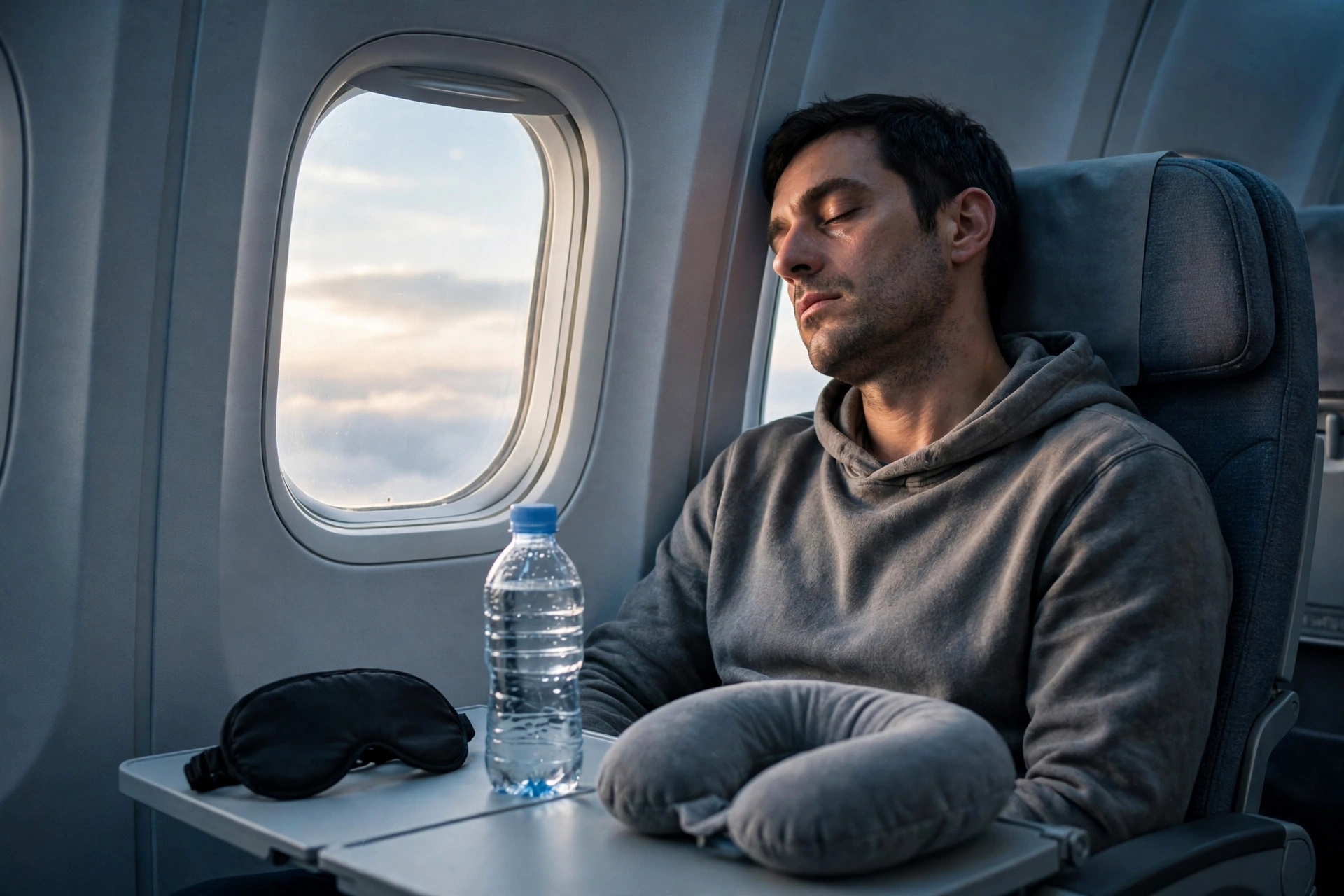
Pack a small sleep kit in your personal item so you can actually rest when the moment comes: an eye mask, earplugs or noise-cancelling headphones, and a neck pillow you can live with. The same thinking that goes into planning a carry-on-only trip for seven days applies — decide in advance what you will need during the flight so the overhead bag never has to be opened mid-journey.
Drink water regularly through the flight: cabin air is dry, and dehydration makes the groggy, headachy feeling worse. Keep a bottle with you and sip often. Alcohol is best avoided too — it fragments your sleep, so even a glass or two can leave you arriving more tired than you would have been without it.
Move around the cabin when you can. A short walk up and down the aisle every couple of hours, plus a gentle stretch in your seat, keeps your circulation going and stops you arriving stiff as well as tired.
Light is your strongest tool, so use it deliberately. If it is daytime at your destination, open the window shade and let the light in; if it is night there, keep the shade down and the eye mask on. Your body clock takes its cues from light more than anything else, so matching the light to your destination’s day and night starts the reset fastest.
The First Day After Landing: Get Outside and Stay Up
The most useful thing you can do on arrival day is get outside into daylight as soon as possible, especially in the morning. Daylight tells your body clock it is time to be awake, and a walk outside — even a slow one — works better than sitting in a bright hotel room. Aim for a good stretch outdoors rather than a quick dash between buildings.
Then stay up until a normal local bedtime. This is the hard part, and it matters most: a long afternoon nap feels wonderful at the time, but it pushes your body clock back toward home time and can leave you wide awake at three in the morning. If you really cannot stay awake, keep any nap under an hour and set an alarm.
Plan a light first day: a gentle walk, a meal somewhere pleasant, and an early night will do you far more good than a packed sightseeing schedule you are too tired to enjoy. Save the big plans for day two.
What to Avoid in the First 48 Hours
Caffeine has its place, but timing matters. A coffee in the morning can help you stay alert; a coffee in the late afternoon can keep you awake when you finally need to sleep. Keep caffeine to the first half of the day for the first couple of days.
Some travellers use melatonin supplements to help reset their sleep. If you are considering them, talk to a pharmacist or doctor first — particularly if you take other medication or have a health condition. The NHS has a clear, plain-language page on jet lag, its symptoms and what can help, which is worth reading before you fly.
Finally, do not expect to feel perfect on day one. Jet lag is temporary: each day you follow the local schedule — daylight in the morning, meals at local times, sleep at local bedtime — moves you closer to normal.
FAQ: Beating Jet Lag After a Long Haul Flight
How long does jet lag last after a long haul flight?
It varies, but as a rough guide your body adjusts by about one time zone a day, so six time zones can take several days to shake off. Shifting your sleep before you fly, using light and meal times, and staying up until local bedtime can shorten that noticeably.
Is jet lag worse flying east or west?
Most travellers find eastward flights harder, because they shorten the day and ask you to fall asleep earlier than your body expects. Westward flights lengthen the day, which is usually easier. Either way, the same tools help: light, sleep timing and staying on local time.
Should I sleep on the plane to avoid jet lag?
Sleep on the plane only if it is night at your destination. Sleeping when it is daytime there pushes your clock the wrong way and makes the first day harder. Set your watch to destination time when you board and let that decide when you rest.
Final Thoughts
Jet lag is not something you can completely avoid, but it is something you can manage. Shift your sleep a little before you fly, choose an arrival time that works for you, sleep and eat on destination time in the air, then get outside into the daylight and stay up until bedtime on arrival day. Do that, and instead of losing your first day to a foggy haze, you will spend it enjoying the place you flew so far to reach.